
Music History Events: Music and Politics
April 22, 1978 Bob Marley headlines the historic One Love Peace Concert in Jamaica, the singer's first appearance in his home country since an assassination attempt two years before. At the concert, Marley manages to unite Jamaican Prime Minister Michael Manley with rival Edward Seaga, who had both been using local warlords to battle for power.
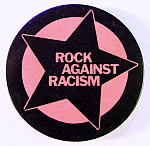 August 29, 1976 The British music magazine Sounds publishes letters responding to Eric Clapton's racist rant at his Birmingham concert earlier in the month. "Own up, half your music is black," one of them states. "You are rock music's biggest colonist."
This particular missive includes a call to action with an address to join Rock Against Racism, "A rank and file movement against the racist poison in rock music." Rock Against Racism soon becomes a viable movement, holding a series of concerts and festivals in support of tolerance.More
August 29, 1976 The British music magazine Sounds publishes letters responding to Eric Clapton's racist rant at his Birmingham concert earlier in the month. "Own up, half your music is black," one of them states. "You are rock music's biggest colonist."
This particular missive includes a call to action with an address to join Rock Against Racism, "A rank and file movement against the racist poison in rock music." Rock Against Racism soon becomes a viable movement, holding a series of concerts and festivals in support of tolerance.More
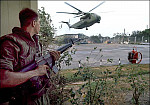 April 29, 1975 Bing Crosby's "White Christmas" marks the end of the Vietnam War as the American Radio Service plays the tune during the Fall of Saigon - a signal for American personnel to evacuate. Many songs were written in reaction to the war, which ramped up in the late '60s. A few songs, notably "Still in Saigon" by The Charlie Daniels Band and "Born In The U.S.A." by Bruce Springsteen, explore the plight of veterans on their return home.More
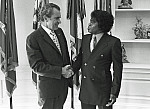 October 10, 1972 James Brown alienates much of his audience by meeting with President Richard Nixon in the White House and endorsing him in his bid for re-election.More
January 30, 1972 British soldiers open fire on 26 unarmed civilians during a peaceful protest march in Derry, Northern Ireland, resulting in 14 deaths. The incident inspires Paul McCartney to write "Give Ireland Back To The Irish" (Wings' debut single) and gives rise to the U2 song "Sunday Bloody Sunday."
May 2, 1971 It's day two of the Mayday protests, as demonstrators fed up with the war in Vietnam try to shut down the US government by blocking off streets and bridges in Washington, DC. Thousands of arrests are made, many to bystanders who have nothing to do with the protest. At the foot of the Washington Monument, where much of the action is taking place, Jonathan Edwards performs his new song, "Sunshine." As the arrests continue, he plays the song over and over, "because there's no better song for the soundtrack of that movie."
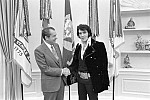 December 21, 1970 Music and politics collide when Elvis Presley meets President Richard Nixon at the White House. A famous photo of the two shaking hands horrifies many Elvis fans.More
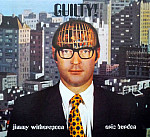 November 7, 1970 MGM Records president Mike Curb announces that his label is dumping 18 acts that "exploit and promote hard drugs through music."More
July 17, 1970 The Guess Who perform at the White House for President Richard Nixon and his royal guests, Prince Charles and Princess Anne. They do not play their hit "American Woman," as they are asked to refrain from performing it "as a matter of taste."
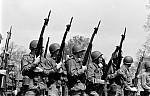 May 4, 1970 Later memorialized in the Neil Young song "Ohio," the Ohio National Guard fires on protesters at Kent State University, killing four students, two of whom weren't even protesting. This shameful event in American history leads to the formation of Devo, as Mark Mothersbaugh and Jerry Casale are both on campus and horrified by the events.More
September 29, 1969 Merle Haggard releases "Okie From Muskogee," a song that protests Vietnam war protesters. The single goes on to reach #1 on the Country chart and #43 on the Billboard Hot 100.
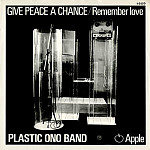 June 1, 1969 John Lennon and Yoko Ono record "Give Peace A Chance" to close out their "bed-in" in Montreal.More
October 7, 1968 Long before the US National Anthem becomes a performance piece, the Puerto Rican singer Jose Feliciano makes waves when he does a slow, jazzy version of the song before Game 5 of the World Series between the Tigers and Cardinals. Among those joining the uproar are Tigers starting pitcher Mickey Lolich, who complains that the overly long rendition screwed up his pregame routine.More
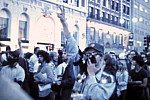 August 28, 1968 At the Democratic National Convention in Chicago, overzealous police in riot gear brutally beat protestors who are demonstrating against the Vietnam War. The Doors, Graham Nash and Chicago all write songs about it.More
June 5, 1968 Senator Robert Kennedy is shot three times while exiting through a kitchen at a hotel where he delivered a speech after winning the Democratic nomination for president of the United States. This event prompts David Crosby to write "Long Time Gone" and The Rolling Stones to insert the lyrics, "Who killed the Kennedys?" to their new song "Sympathy For The Devil."
March 17, 1968 Mick Jagger joins a demonstration at Grosvenor Square in London to protest the Vietnam War. When the group, estimated at 25,000, marches to the American embassy, they are met with police resistance and rioting ensues. Jagger leaves the protest before it reaches the embassy, but uses the events as inspiration for the Rolling Stones song "Street Fighting Man."
January 18, 1968 At a White House luncheon to discuss the rise in urban crime, Eartha Kitt gets into a notorious spat with First Lady Claudia Taylor "Lady Bird" Johnson, declaring, "Vietnam is the main reason we are having trouble with the youth of America. It is a war without explanation or reason." Although accounts of the entire argument differ, Kitt is subsequently blackballed in America.
November 22, 1963 US president John F. Kennedy is assassinated in Dallas, Texas. The incident inspires several songs, including Connie Francis' "In The Summer Of His Years" and The Beach Boys' "Warmth Of The Sun."
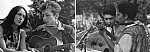 August 28, 1963 At the March On Washington, where Martin Luther King, Jr. gives his "I have a dream" speech, Bob Dylan, Joan Baez, Odetta and Mahalia Jackson sing for equal rights.More
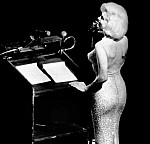 May 19, 1962 Less than three months before her death, Marilyn Monroe makes one of her last public appearances at President John F. Kennedy's 45th birthday celebration, where she famously sings "Happy Birthday, Mr. President" in his honor.More
January 19, 1961 The night before John F. Kennedy's inauguration, Frank Sinatra throws a star-studded gala to eradicate the Democratic Party's $2 million campaign debt. With the help of Peter Lawford, fellow Rat Packer and husband of JFK's sister Patricia, Sinatra enlists elite entertainers for the evening, including Nat King Cole, Harry Belafonte, Gene Kelly, Ethel Merman, and actors Laurence Olivier, Janet Leigh, Tony Curtis, and Bette Davis.More
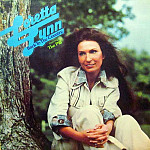 May 9, 1960 The birth control pill is introduced in the US, inspiring Loretta Lynn to sing a song about it.More
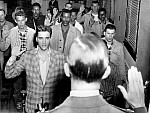 March 24, 1958 Elvis Presley goes to the Memphis Draft Board and enters the United States Army.More
September 2, 1957 Pete Seeger plays "We Shall Overcome" at the Highlander Folk School in Tennessee as part of its 25th anniversary celebration. On hand is Martin Luther King, Jr., who gives the closing speech at the celebration. The song becomes ingrained with the civil rights movement as King and Seeger fight for equality.
August 18, 1955 Pete Seeger testifies before the House Un-American Activities Committee, where he is asked if he has performed for communists. Seger replies: "I have sung for Americans of every political persuasion, and I am proud that I never refuse to sing to an audience, no matter what religion or color of their skin, or situation in life. I have sung in hobo jungles, and I have sung for the Rockefellers, and I am proud that I have never refused to sing for anybody."
February 8, 2026 Providing an alternative to Bad Bunny's Spanish-language Super Bowl halftime show, Kid Rock, Brantley Gilbert, Lee Brice and Gabby Barrett play the "All-American Halftime Show" to a streaming audience. It's billed as a celebration of "faith, family, and freedom."
January 20, 2025 President Donald Trump joins The Village People on stage when they headline the Liberty Ball, part of his inauguration festivities - their song "Y.M.C.A." was a staple at his rallies. Billy Ray Cyrus, Nelly and Jason Aldean also take the stage; other acts performing at inauguration events include Kid Rock, Rascal Flatts, Gavin DeGraw, Parker McCollum and Carrie Underwood, who sings "America the Beautiful" without a backing track at the swearing-in ceremony when there's a technical glitch.
August 20, 2024 At the Democratic National Convention, a DJ plays songs for every state as they announce their roll call votes for eventual nominee Kamala Harris. Songs include "I'm Shipping Up to Boston" by Dropkick Murphys for Massachusetts, "Mr. Brightside" by The Killers for Nevada, and "Born in the U.S.A." by Bruce Springsteen for New Jersey. Lil Jon shows up to personally perform "Turn Down For What" for Georgia.
March 26, 2024 Donald Trump partners with Lee Greenwood, endorsing the God Bless The USA Bible, which includes the chorus lyrics to Greenwood's song. "I'm proud to be partnering with my very good friend Lee Greenwood," Trump says. "Who doesn't love his song 'God Bless the USA'?"
August 23, 2023 The first Republican debate opens with a clip of Oliver Anthony singing "Rich Men North Of Richmond," his takedown of venal and incompetent politicians in Washington, with the candidates asked, "Why is this song striking such a nerve in this country right now?" "It was funny seeing my song in the presidential debate, because I wrote that song about those people," Anthony says.
Back to Categories©2026 Songfacts®, LLC